Table Of Content
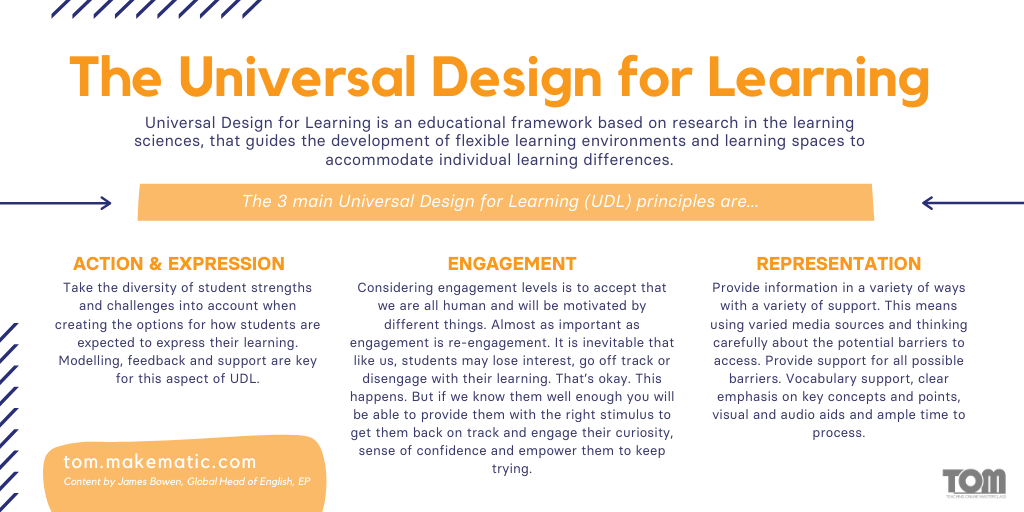
Universal Design for Learning (UDL) is a framework that guides educators in designing learning experiences that meet the needs of all learners. It helps teachers move from a one-size-fits-all approach toward one that adapts to learner variability. UDL embraces the idea that we should have firm goals for students—using flexible means to reach those goals.
Additional CAST resources to explore
Meet OmniPred: A Machine Learning Framework to Transform Experimental Design with Universal Regression Models - MarkTechPost
Meet OmniPred: A Machine Learning Framework to Transform Experimental Design with Universal Regression Models.
Posted: Sat, 02 Mar 2024 08:00:00 GMT [source]
Learn alongside fellow coaches in a collaborative online learning environment. Educators empowered with UDL guidelines can create responsive curriculum and instruction that meaningfully accommodates the nuances of a diverse student body. Whether it is through written work, voice recordings, visual displays, or digital storytelling, providing alternatives is key.
Professional Learning
Embracing Universal Design for Learning with Moodle - Moodle
Embracing Universal Design for Learning with Moodle.
Posted: Thu, 04 Mar 2021 08:00:00 GMT [source]
It acknowledges that each student processes information uniquely, calling for varied ways of presenting material, expressing understanding, and keeping students engaged. Now, this education model is increasingly recognized as vital for inclusive and effective teaching. Introduced by educational researchers in the early 2000s, the Universal Design for Learning provides a framework for offering individualized support and inclusion to students.
Action and Expression

The importance of universal course design cannot be overstated, as it represents a foundational principle for ensuring equitable access and inclusive learning environments. Instructors can proactively address diverse learning needs and foster an environment where every student can thrive by incorporating flexibility, simplicity, and multiple means of representation, expression, and engagement. Moreover, universal design not only benefits students with disabilities but also enhances the overall learning experience for all learners, promoting engagement, participation, and academic success. Embracing universal design principles in course development and instruction is not just a matter of compliance but a commitment to equity, diversity, and excellence in education.
For purposeful, motivated learners, stimulate interest and motivation for learning. For example, closed captioning is often used in noisy places like restaurants and airports to help everyone follow what’s being said on TV. Even if you’re not familiar with the term universal design, you’ve likely encountered it in your everyday life. Common examples include automatic doors and dictation tools on smartphones. After you apply, the financial aid office will determine your financial need and inform you of the federal or private loans that are available to you.
For Current Students

Universal Design for Learning uses inclusive instructional design principles to inform the planning, programming, and assessing stages of the teaching and learning cycle. This supports teachers to use evidence-based strategies and provide multiple options for students when planning teaching and learning experiences. Many of these practices are already used by teachers in NSW public schools. A pivot towards UDL means instructional goals, methods, materials, and assessments are not fixed but instead adaptable. This flexibility promotes equal opportunities for all students, removing barriers that often hinder the learning process, particularly for students with disabilities.
The keystone of UDL is its guidelines, which provide educators with concrete strategies to implement this adaptive approach across all disciplines. You can create flexible options in the design of the goals, assessments, methods, materials, and environment — and make them available for all your students. Other examples of UDL in the classroom include letting students complete an assignment by making a video or a comic strip. To get a deeper understanding of UDL, it also helps to see how it’s different from a traditional approach to education.
What is Universal Design for Learning?
This means developing a flexible learning environment in which information is presented in multiple ways, students engage in learning in a variety of ways, and students are provided options when demonstrating their learning. Universal Design for Learning (UDL) is a framework developed by CAST, an Understood founding partner. UDL guides the design of learning experiences to proactively meet the needs of all learners.
Practicing UDL in courses means maximizing opportunities to learn by making room for a range of abilities and methods of expression. Following the principles of UDL, instructors go “beyond compliance” with the Americans with Disabilities Act (ADA) and aim to provide the maximum access to the greatest number of their students. By applying UDL principles, teachers can effectively instruct a diverse group of learners. They do this by building in flexibility in the ways learners can access information and in the ways students can demonstrate their knowledge. Universal Design for Learning (UDL) is a way of thinking about teaching and learning that helps give all students an equal opportunity to succeed. This approach offers flexibility in the ways students access material, engage with it and show what they know.
UDL's implications stretch well beyond accommodating students with disabilities; it is a boon for all learners. By addressing the broad spectrum of engagement, representation, and comprehension, the UDL framework equips educators to craft a curriculum that meets diverse learning needs. At its core, UDL emphasizes the creation of instructional goals, methods, materials, and assessments that are inherently flexible. This adaptability ensures that learning experiences are tailored to the individual requirements of each student. Research on student learning demonstrates that multi-modal access helps to improve learning outcomes for all students. Multi-modal access essentially means providing several pathways to access course material.
Past workshops listed usually include video, slides, and other documentation. You might notice that the digital accessibility of these items ranges (for example, some videos are carefully edited with chapters and accurate captions, and some are not yet). Offering these workshops was a part of our own collective learning processes; now that we know better, we can do better! UDLA trainings support the lesson planning process and help shift your ideas about what curriculum can be and how to get there over time.
This program is designed for working professionals who desire to advance their career in instructional design. Provide multiple means of action and expression for learners to demonstrate what they have learnt. UDLA has options that support self-directed learners (resources, automated course) to more those that prefer more structure and guidance (in-person workshops, moderated online course work).
These principles encourage educators to offer multiple ways for students to become involved with their learning, understand the information, and demonstrate their knowledge. Promoting equitable practices is not just about access; it's about ensuring that all learners encounter challenging and engaging learning experiences. What UDL brings to the classroom is a blueprint for equity, one that is critical in offering not just equality but also the recognition and celebration of every student's potential. At its core, UDL seeks to expand learning access by minimizing common obstacles such as those that are physical, cognitive, and organizational. These foundations help shape learning environments that are both effective and inclusive, thereby offering educators structured strategies to meet an array of student needs.
Use of these 3 principles by teachers in their curriculum planning practice can optimise learning for all students, not just the mythical ‘average’ learner. Teachers incorporate multiple means to represent lesson content and provide learners with a variety of options demonstrate their learning. Embodied in the mission of UDL is the goal to dismantle learning barriers for all, particularly for students with disabilities. The framework's holistic approach - which encompasses multiple means of representation, action, and engagement - seeks to cater to the diverse needs of learners.




No comments:
Post a Comment