Table Of Content

• Allow students to show what they know through a variety of formats, such as a poster presentation or a graphic organizer. Watch a video of what UDL looks like in the fifth-grade classroom of Understood Teacher Fellow Eric Crouch.
What type of school are you?
Engagement strategies also include game-like elements and physical activities to sustain interest. It is through adherence to these principles that UDL successfully fosters an inclusive learning atmosphere where barriers are systematically identified and dismantled. Even if you’re not familiar with the term universal design, you’ve likely encountered many examples of it in your everyday life. Closed captions, automatic doors and accessibility features on smartphones are all examples of universal design. First-time registrants need to create a Professional Education account to register. We welcome participants who have a basic understanding of UDL, are eager to deepen their UDL practice, and are motivated to develop into UDL leaders at their schools.
Programs
Olympia School District lays out 2023-2024 professional learning plan - The JOLT - The Journal of Olympia Lacey & Tumwater
Olympia School District lays out 2023-2024 professional learning plan.
Posted: Mon, 16 Oct 2023 07:00:00 GMT [source]
UDL frameworks provide examples like detailed outlines to aid in organization and graphic organizers to support idea development. Explore Universal Design for Learning (UDL) strategies to enhance accessibility and engagement for all students. As a teacher, I involved students in tracking and monitoring their goals by creating digital Data Notebooks where we tracked academic, behavioral, and other goals.
How: Engage with UO Workshops & Communities of Practice
You don’t need specific tools or technologies to follow UDL’s principles either. Instead, your students choose from the tools and resources you already have. For strategic, goal-directed learners, differentiate the ways that students can express what they know.
UDLA has technical assistance and PD options that guide teams through the stages of implementation. UDLA provides PD that not only teaches UDL but allows for coaches to practice how they might support teachers in the field. UDL is a research-based framework that places great emphasis on building self-directed learners. Learners will explore the factors that drive motivation and how those can be leveraged in the classroom.
Is your school involved in any staff development projects?
Training and practice helps you slowly implement over time so that you aren’t overwhelmed but can slowly build towards mastery. As you improve in your implementation, your instruction and design will be more effective. By addressing these areas, educators can create a space for an inclusive approach that caters to a wide range of needs and preferences. Consequently, the UDL framework serves as a valuable tool in providing multiple methodologies for content acquisition, knowledge demonstration, and the maintenance of motivation. Teachers might allow learners to select topics they find meaningful or decide between creating a video or a comic strip to display their understanding.
History of Universal Design for Learning
Embracing the following four beliefs is the first step in designing learning experiences that serve all students. Universal Design for learning is a set of principles that provide teachers with a structure to develop instructions to meet the diverse needs of all learners. UDL is similar to universal instructional design and universal design for instruction. All three advocate for accessible and inclusive instructional approaches that meet the needs and abilities of all learners.
By using Universal Design for Learning, all students can benefit from increased access to their course content, including many who are not registered to receive formal accommodations through the Disability Resource Center (DRC). Stigma, cost, and numerous other factors are barriers to registering with the DRC. As the COVID-19 pandemic has shown, all people are affected by changes to their environment, be it social or academic.
Differentiated Instruction Made Practical
Universal Design for Learning (UDL) is an educational framework that leverages scientific knowledge about human learning processes to create flexible learning environments. UDL aims to provide all students with equal opportunities to succeed by removing barriers and accommodating individual differences. To address the remarkable variability among students in today’s diverse learning environments, educators are increasingly turning to Universal Design for Learning (UDL). UDL offers a framework for guiding the design of learning opportunities that are inclusive and challenging for all learners. Equitable course development recognizes that students have a diverse range of abilities, environments, and experiences and incorporates multiple means of learning and expression for these students. By prioritizing accessibility in a course, instructors design their course from the vantage point of multiple perspectives, creating learning experiences that can engage a diverse group of students.
Series from the EDUCAUSE Learning Initiative (ELI) provides concise information on emerging learning technologies. Each brief focuses on a single technology and describes what it is, where it is going, and why it matters to teaching and learning. You could share a mini-lesson on butterfly metamorphosis and have students use a guided worksheet as they write. Or you could set up stations where students are grouped using flexible grouping around understanding of the topic, language ability, or reading level.
UDL is regarded so highly that it’s mentioned by name in the nation’s main education law. The Every Student Succeeds Act (ESSA) encourages states and districts to use federal funding to help teachers expand the use of UDL. This site is a joint resource provided by the Teaching Engagement Program and UO Online. Situated within the Office of the Provost, our units work collaboratively to support the teaching mission of the University of Oregon.
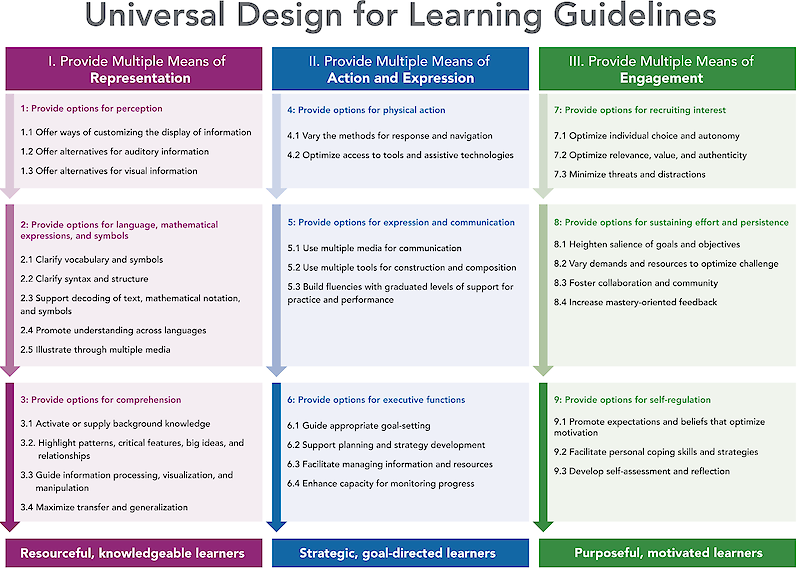
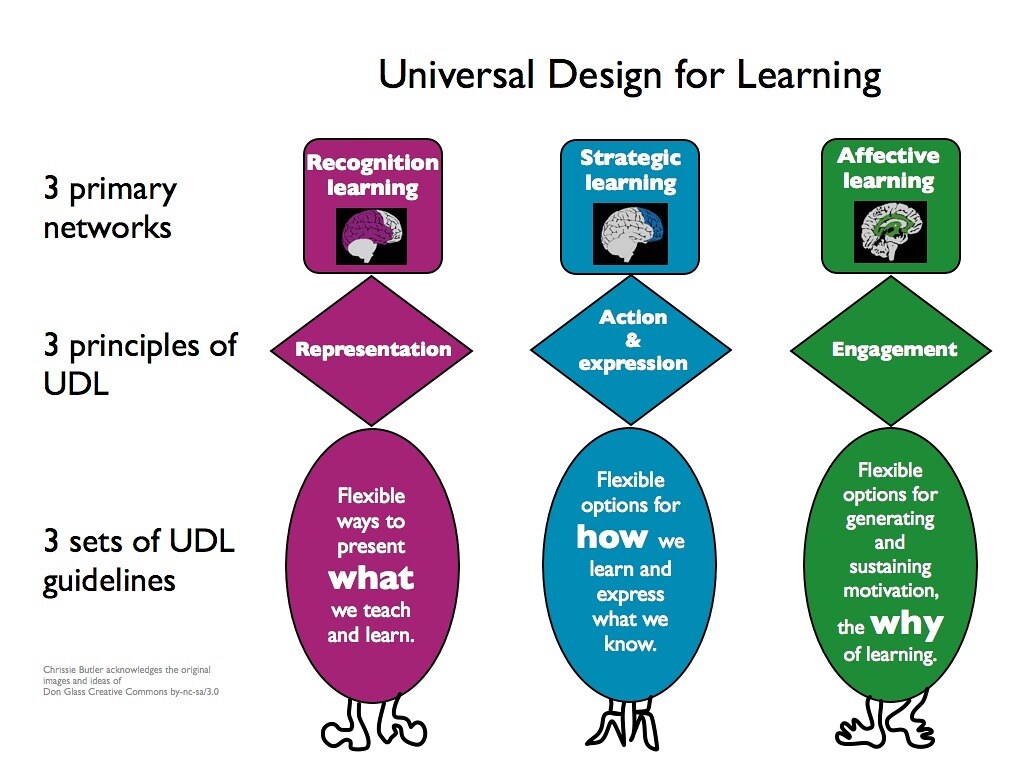
See more on UDL principles and how they can be applied, or use a course accessibility checklist to check how accessible your course is. UDL describes human variability based on parts of the brain that manage the “why” (affective network), the “what” (recognition network), and the “how” (strategic network) of learning. Watch as CAST co-founder David Rose explains why UDL emphasizes variability instead of disability.
These guidelines offer a set of concrete suggestions that can be applied to any discipline or domain to ensure that all learners can access and participate in meaningful, challenging learning opportunities. In the same way, Universal Design for Learning can help all learners reach their full potential. Learners receive and process information in different ways, work at different rates, have varied family and cultural backgrounds and bring different knowledge and experience to their learning. It is important to plan, program, teach and assess using evidence-based practices that cater for the full range of students.
What defines effective implementation of UDL is the establishment of classrooms that welcome and support individuals from varied backgrounds, embracing their unique abilities rather than sidelining them. Educators are encouraged to recognize that students will vary in how they express what they know. UDL's principle of multiple means of action and expression suggests that students should be allowed to demonstrate their understanding in a variety of ways.
For educators, this means designing lessons that are not overly complex or unnecessarily complicated. Whether a student is grappling with language barriers, learning English as a second language, or facing other language-related challenges, UDL strategies strive to make content accessible and engaging. Universal Design for Learning (UDL) takes a broad and inclusive stance toward education, recognizing the rich diversity of students' language skills. It acknowledges that learners come from a variety of linguistic backgrounds, each with unique challenges and abilities. Central to UDL is the goal of granting full access to learning for every student, a goal that is especially pertinent when it comes to language. It offers a trio of learning modalities--multiple means of representation, expression, and engagement--that are central to its customized approach.




No comments:
Post a Comment